
Labor History: The First Industrial Workers of the World Local in Maine

On August 27, 1906, workers at the Marston Worsted Woolen Mill in Skowhegan, Maine formed Pioneer Local 379 of the radical Industrial Workers of the World (IWW). The IWW was an anti-capitalist union formed in 1905 in Chicago by socialists, anarchists and industrial unionists. It sought to unite all workers into "One Big Union" and abolish capitalism, organizing by industry rather than specific trades.
The local likely formed out of a branch of the Socialist Trade and Labor Alliance, a revolutionary socialist labor union closely linked to the Socialist Labor Party (SLP), which had a presence in Maine since 1895. SLP leaders eventually merged the SLP with the IWW at its founding convention in Chicago in 1905. During its existence, the STLA essentially operated as the revolutionary, "dual union" wing of the SLP. At the time, the conservative American Federation of Labor had no interest in organizing women and people of color, which is why they either organized with more radical unions like the STLA and the IWW or were simply independent of any established union. It's estimated that more than 11,000 women went on strike in Maine alone between 1881 and 1900.
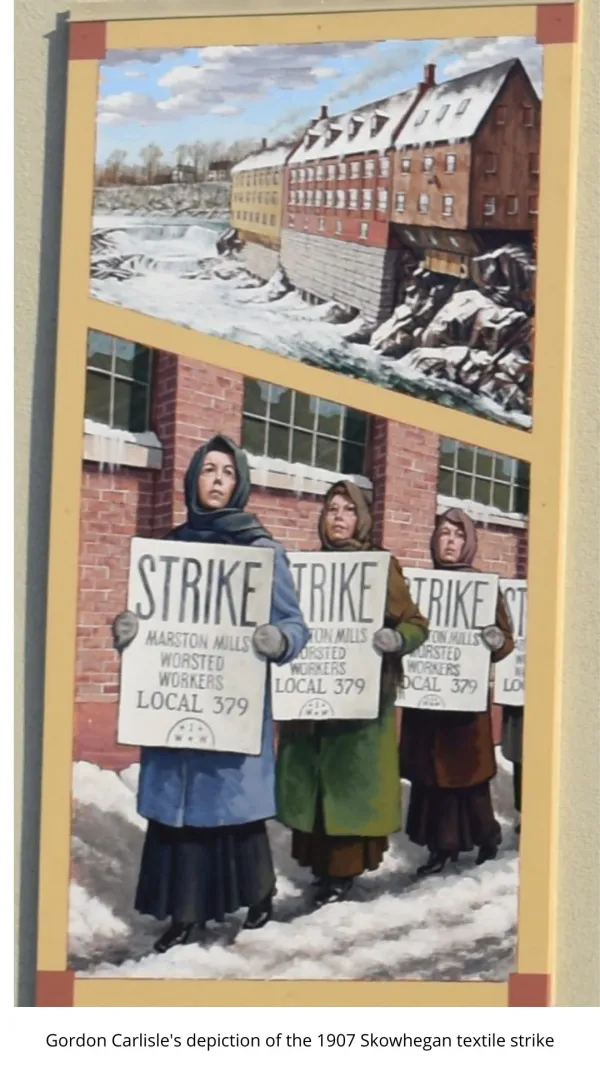
As historian Carol Toner writes, women textile workers in Maine dealt with deplorable working conditions including substandard boarding houses and a lack of clean drinking water, sanitary bathroom facilities, and fire escapes. They also were paid less than men for the same work.
Conditions for women textile workers were horrible and they, like their male counterparts, sought "more and better boarding houses, cleaner drinking water, more and safer fire escapes, private and sanitary bathroom facilities, higher wages, equal pay for equal work, and unions to represent women’s interests."
In the spring of 1903, trade unions at the Marston Worsted Woolen mill organized under the Socialist Trade and Labor Alliance to demand the company cease using the “two-loom system,” an industrial textile manufacturing arrangement where a single weaver operates two separate cloth-producing looms at the same time. The system forced weavers to work harder for the same amount of money. The two-loom system was of the main grievances of the IWW’s 1913 Paterson Silk Strike and the 1912 Lawrence “Bread & Roses” Strike.
At a secret meeting of the Socialist Trade and Labor Alliance on the evening of April 11, 1903 Marston Worsted workers got into a physical fight during a spirited discussion over whether to strike. Weaver Arthur MacVeigh was one of the leading the strike proponents, while loom fixer Patrick J. Morris led the anti-strike faction. Loom fixers were some of the most skilled jobs in the mill.
While Morris did not attend the meeting, he heard reports that MacVeigh had made “slanderous threats” against him. Morris proceeded to wait outside H.P. Merwin’s cigar store where the union meeting was held at the corner of Water and Russell Streets and asked MacVeigh to come outside. At a court hearing days later, McVeigh testified that Morris didn’t say a word to him, but knocked him down as soon as he stepped out of the door. He exhibited a black eye to the court and claimed Morris kept pounding and kicking him while he was down.
Morris claimed that he civilly called McVeigh outside to ask him why he had been bad mouthing him. He claimed MacVeigh attempted to throw the first punch, so he acted in self-defense. He said he punched MacVeigh in the eye and he immediately went down because he had been drinking heavily. The judge found Morris guilty of assault and battery and sentenced him to 60 days in jail.
While it doesn't appear that the STLA ever ended up going on strike, the reformed IWW local was much more militant.On January 21, 1907, the 225 workers with Local 379, most of whom were women, walked out of the mill and went on strike to protest the company’s rescinding of a promised wage increase and the firing of Mamie Bilodeau, a 17 year old worker who complained of sexual harassment by an overseer named Charles North.
According to I.W.W. organizer Samuel J. French, a founding I.W.W. member and Socialist Trade and Labor Alliance leader, the Marston Worsted workers formed I.W.W. Pioneer Local 379 because wages weren’t catching up to the increasing cost of living. The workers believed that unionizing on an industrial scale, rather than by craft, was the most effective way to fight for better wages and working conditions. The workers demanded a wage increase, the firing of Charles North, the abolition of fines for imperfect work and representation on an arbitration committee." As French wrote in the Industrial Union Bulletin on March 2, 1907:
“Is it not a fact that the Marston Mill is notorious as belonging to that class of slave pens in which the conditions under which the employees labor are mean and degrading and the wages such as one can be said to but barely subsist upon rather than live?... Is it not a further fact that some of the petty bosses employed there are that type unfortunately all too common, who are products of modern industrial life, who, while they may have acquired considerable knowledge of the mechanical end of their business, have, owing to the fact that their childhood, youth and manhood days had to be given up to the perpetual grind of the factory while becoming a mechanic, had no chance to learn anything else, to develop their minds or characters or become acquainted with the little amenities of life that go to make up civilized human beings, and are thus mere degraded and brutalized attachments to the mechanism of the mill to aid in grinding profits out of the hides of wage workers?”
The American Federation of Labor despised its radical union counterpart and the United Textile Workers of America, AFL President John Golden even collaborated with the company to bring in strikebreakers, but the effort was ultimately unsuccessful. After a round of negotiations with the company, the strikers won the end the end of fines for imperfect work, the abolition of pay by piece work, recognition for a union-elected grievance committee and reinstatement of forty-two workers who had been fired for union activity. The following July, the company granted a second five-percent pay increase. At a mass meeting, the strikers voted to return to work on April 13. The Kennebec Journal reported "a general feeling of rejoicing in town [now] that the strike, the longest ever known in industrial Skowhegan, is now a thing of the past."