
Labor Organizer and Author Peter Kellman to Be Awarded Working-Class Hero Award

PHOTO:Peter Kellman speaks at an exhibit commemorating the Jay strike in 2024 at Lewiston.
At our upcoming COPE Convention on June 25, we will present longtime labor organizer and author Peter Kellman (UAW 1981-National Writers Union) with the Working Class Hero Award for teaching all of us to use history as an organizing tool, for developing the leadership and analysis of so many labor activists and for putting his life into building people’s movements.
Kellman became active in the Civil Rights Movement in the 1960s, before joining the Labor Movement in the 1970s and leading anti-nuclear protests in the early 1980s. He is perhaps best known for his work as an organizer during the 1987-88 International Paper Strike in Jay. He is the author of the book Divided We Fall: The Story of the Paperworkers' Union and the Future of Labor,Building Unions - Past, Present and Future and most recently co-wrote a comic book called “Obey Now, Grieve Later” with Mike Konopacki and Libby Devlin.
Kellman was born in Brooklyn, New York in 1946 to Jewish union shipbuilders who met while working at the Brooklyn Naval Shipyard during World War Two. His mother was a shipfitter and his father was a trainer, which was the best job he could get at that time due to anti-Jewish discrimination. Kellman’s parents didn’t have vacations, but they were allowed one week off to get married. They worked nine days on, with one day off. They were staunch left-wing unionists and Kellman grew up steeped in politics. His mother brought him to his first picket line in a baby carriage at a bank where workers were striking for union recognition. His grandfather happened to be a customer of the bank, but he didn’t cross the picket line with his daughter and grandson there.
When Kellman was six, his family moved to Salem, NH in 1952 where he attended grade school. New York City was getting too expensive and his parents wanted to own their own home and have a garden. While living in Salem, Kellman’s parents befriended an old couple. The man asked young Peter if he had ever heard of Big Bill Hayward or Elizabeth Gurley Flynn.
“I had no idea,” recalled Kellman. “He said, ‘Have you ever heard about the great strike in Lawrence in 1912?’ I said, ‘No.’ I was almost feeling guilty.”
The old man informed Kellman that Haywood and Flynn were leaders of the Industrial Workers of World during the Bread and Roses Strike and that they had stayed on his farm outside Lawrence because they had food. Kellman said the story inspired him to become both a farmer and a labor organizer.
“I've always had big gardens to grow food and been involved in organized labor,” he said.
Civil Rights Work From Maine to Selma, Alabama
In 1959, the Kellman family moved to Sanford, Maine after his father took a job there. After finishing high school, he attended the University of Maine where he played football. But he hated school and left as soon as he finished his last class of his freshman year. He went down to New Hampshire to work for the World Fellowship Center, which provides social-justice related workshops, lectures and other progressive programming. It was there he met Socialists Scott and Helen Nearing, who would later write “Living the Good Life,” which became known as the Bible of the Back-to-the-Land Movement. The Nearings hired Kellman to work at their homestead at Harbourside, Maine for a brief period. Then in 1965, he took a job working as a full-time field secretary for the Committee for Non-Violent Action (CNVA) in Voluntown, Connecticut. While working for CNVA, Kellman participated in and organized demonstrations against the Vietnam War right before the U.S. launched Operation Rolling Thunder with aerial strikes on North Vietnam.
On February 20, 1965, Kellman, who was an apprentice carpenter at the time, organized an anti-war demonstration of more than 350 students in front of the White House. The event attracted 30 protesters from the conservative group Young Americans for Liberty. A poll four days earlier found 67 percent of Americans approved of the bombing of North Vietnam.
“I remember being blown away when a busload of students from a Midwest women’s college arrived,” recalled Kellman. “For me, that busload of students was the beginning of my experience of what happens when a mass movement begins to form.”
Kellman later learned that the FBI was monitoring the event and his name was mentioned in its report. He recalled attending a vigil outside the Pentagon when a high-ranking military officer walked up with his young son and said to him that the protestors were what was wrong with America.
“The image of this military officer with the massive Pentagon building and all it stood for behind him lecturing his young son will never leave me,” Kellman wrote. “We were what was wrong with the country? Another time during the week we went into the Pentagon and walked about putting ‘End the War’ stickers in the restrooms and I walked by the offices of the Joint Chiefs of Staff and put one on their door! Man, has security changed since then!”
After he returned from Washington D.C., CNVA sent Kellman to represent them on the civil rights march from Selma to Montgomery, Alabama. He led a crew of 50 seminarians along with actor Gary Merrill in setting up the tent sites for the marchers. He also helped build a Free Library. Kellman ended up volunteering with the Student Nonviolent Coordinating Committee (SNCC) in Alabama and worked on organizing independent political parties. After his work with SNCC, Kellman began organizing the anti-draft movement and the Assembly of Unrepresented People in Washington, DC, which was the first mass arrest demonstration against the Vietnam War. In 1967, Kellman and his wife went into exile in Canada, where he worked in construction and became certified as an engineering technician. Then in October, 1973, he was arrested trying to reenter the U.S. for violating the Selective Service Act. But Federal Attorney Sumner Peter Mills Jr., the father of Governor Janet Mills, later dropped the charges against Kellman.
Joining the Labor Movement
In 1975, Kellman got involved in union organizing while working in the rubber mill portion of the Converse shoe factory in North Berwick, Maine. Kellman sought to organize the 500 workers at the factory, but was fired for his efforts. He later won a National Labor Relations Board case against the company for his unjust firing, but he never got the job back because the plant was closing. The following year, he got involved in the anti-nuclear movement, working with a group called the Clamshell Alliance to organize protests against the construction of the Seabrook State Nuclear Power Plant in New Hampshire.
In 1979, Kellman went to work at the Laconia Shoe Shop in Sanford, where he was elected president of Local 82, Shoe Division, of the Amalgamated Clothing and Textile Workers Union. It wasn’t long before his rabble rousing got him in trouble again. The company had Kellman arrested for refusing to take down a leaflet from the bulletin board calling for the Maine Yankee Nuclear Plant to be shut down. Two other workers were also arrested for protesting on the shop floor. The following Monday, 150 workers in the plant came in with anti-nuclear buttons on, rallying to the arrested workers’ defense.
“I then got a call from the plant managers saying, ‘Peter, come back to work and we'll ask the county to drop the charges. We'll pay you and the two other people who got arrested for your time off.’” He added, “The charges were dropped because we all stuck together, but if you tell people today that you would get arrested at work and not only keep your job, but be paid for time off, they’ll think you're crazy.”
Kellman attended his first Maine AFL-CIO Convention in 1979. In 1980, he was appointed the chair of the federation’s Committee on Run-Away Shops and worked on the implementation of, and improvement of, Maine’s first-in-the-nation run-away shop law under which employers were required to give Maine workers notice of plant closing and severance pay. He also took the environmental fight to the labor movement, urging union members to back a referendum to shut down Maine Yankee. Maine AFL-CIO President Charles O’Leary was adamantly opposed to the resolution, but Building Trades unions were angry that union contractors were not awarded any bids to work on the plant so they did not oppose the measure. One union put some pro-Maine Yankee material on a table at the convention, but Kellman got the flyers removed because they didn’t include a union bug on the flyers. The anti-nuclear flyers had the union bug so they stayed.
Kellman later joined the Painter's Union, where he became a shop steward. In 1984, he was the campaign manager on a congressional campaign in New Hampshire’s First District. When he returned to Maine in 1986, he went to work for the Maine AFL-CIO getting union members involved in legislative races. While working on a legislative campaign that year for a candidate named Dick Tracy, a union paper millwright from Rome, he got to know members of United Paperworkers International Union Local 14 at the International Paper Mill in Jay. A year later, he was working for the Maine AFL-CIO as an organizer helping workers locked out of the Simplex Wire and Cable Plant in Newington, New Hampshire.
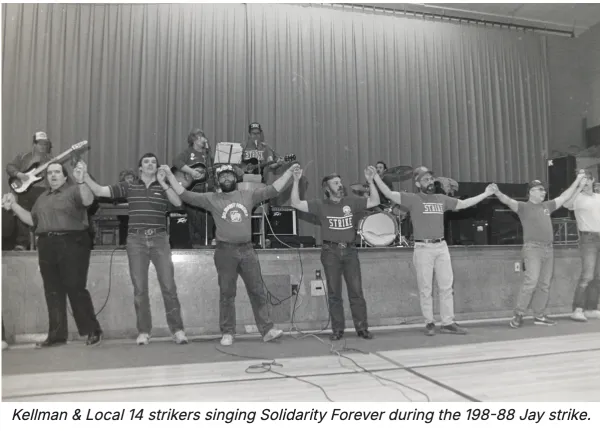
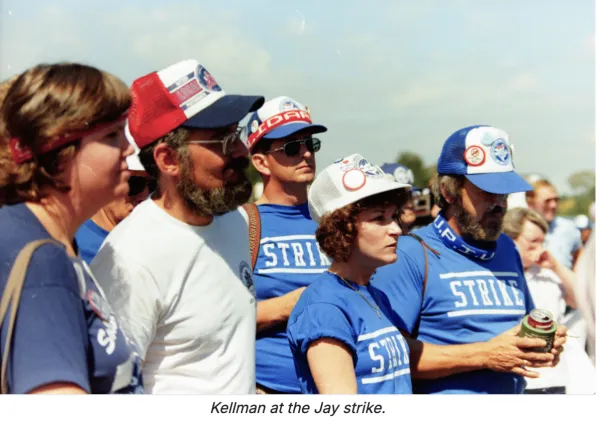
He went on to help UPIU Local 14 in Jay prepare for a strike on June 16, 1987. IP's demands included the elimination of overtime pay on Sunday, no more Christmas Day holiday, the elimination of 156 jobs and the contracting out of all maintenance work which would have eliminated 350 jobs and what amounted to the elimination of the grievance procedure. The Jay workers joined locals locked out in Mobile, Alabama, and struck with IP workers in Lockhaven Pennsylvania and De Pere, Wisconsin.
Kellman organized a union speakers’ committee to visit different UPIU locals across Maine and the country. He also helped set up the strikers’ food bank and trained a committee of strikers on media relations. He created the agenda for mass meetings and found members to speak at them. He even found a musical group of strikers to play at the meetings. Meanwhile, the international set up a corporate campaign to pressure the company to settle. Kellman also enlisted the help of Building Trades unions to the Jay strikers and held a rally of 2,000 people on the state capital.
For nearly a year and a half, the strikers held weekly mass meetings attended by over 1,000 people. Even as the company permanently replaced workers, the strikers pressed on, generating international attention. Strikers ran and won seats on the local Jay Select Board and in the State Legislature. The strikers held out for 16 months until October 1988 when the UPIU’s International President, Wayne Glen, reversed his position and agreed to sign contracts at other IP locations, thus isolating the striking locals. Kellman would later work for the New Hampshire AFL-CIO, but he got into a serious car accident that interrupted his work for several months due to his injuries. He would go on to receive a bachelors degree in Labor Studies from the University of Massachusetts.
Using Labor History as an Organizing Tool
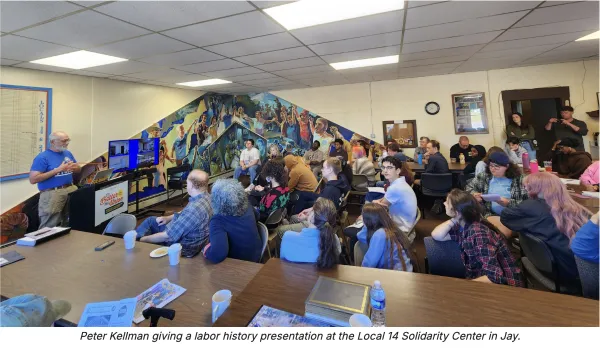
Kellman started using labor history as organizing tool, writing the book "Divided We Fall: The Story of the Paperworker's Union and the Future of Labor,” which explains the plight of workers in the paper industry from a historical context. He also coordinated the Jay-Livermore Falls Working Class History Project that published the book “Pain on Their Faces: Testimonies on the Paper Mill Strike in Jay, Maine, 1987-1988,” featuring accounts of the strikers themselves. As President of the Southern Maine Labor Council in the early 2000s, Kellman came up with the idea to do a labor history moment at every meeting and recruited union members to come and tell the history of their unions. He worked with professors at the University of Southern Maine to develop a Labor Studies Minor and they eventually developed a proposal to create what became known as the Scontras Center for Labor and Community Education.
In recent years, Kellman has been working with the Scontras Center and Local 14 Solidarity Center at the old Jay union hall to continue his working-class history project. He gives talks on organizing and labor history to college and high school classes. Looking at the state of the labor movement today, he laments that it has failed to come up with an effective strategy to reverse the decline of unions.
“We haven't changed the way we do anything. We're doing everything exactly the same and it doesn't work,” he says. “Every time there's a little bit of a success, people think things have turned around. And it never does because we do things exactly the same. We don't have a basic strategy.”
By working with educational institutions, Kellman hopes to institutionalize the teaching of labor studies for younger generations and build more class consciousness. He finds inspiration in the Knights of Labor, which came to prominence in the 1880s as a mass movement of workers and others engaged in “honorable toil” to surpass capitalism and create a Cooperative Commonwealth. The Knights, he says, saw workers as a community, not as simply a group of people in a particular workplace.
“They had a broad vision of what they wanted the society to look like,” he said. “They knew there couldn’t be a disparity of wealth and income and have a democracy because the rich people always end up dominating the way they always have in this country.”
When the American Federation of Labor came along, he said, the mainstream labor movement was more focused on contracts with employers than politics. As a result, they became narrowly focused on delivering for members but not necessarily for the broader working class.
As Kellman likes to say, “We need to recover the disappeared story of the struggle of common people to create a democratic culture. We need to inject into the current debate a vision of a just society where competition is replaced with cooperation, where greed is replaced with love allowing power to be shared by all.”
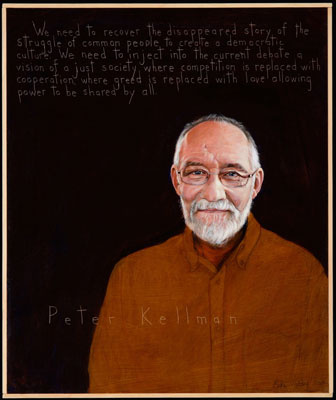
Portrait of Peter Kellman by Robert Shetterly.