
Firefighters Reform Union as IAFF Local 740, Take On Anti-Labor City Manager

When the Portland Firefighters finally got organized again after losing their union in 1922, a bloody world war had broken out in Europe and Asia. For many years, they had struggled to maintain their pay and benefits they had as municipal revenues shrank during the Great Depression. It was hard enough to win any improvements even during good times. This is the story of how the Portland Professional Firefighters, IAFF Local 740, rose like a phoenix from the ashes of Local 133.
In 1923, the Ku Klux Klan and the Chamber of Commerce backed a successful referendum to replace the nearly century-old Council-Mayor form of municipal government with a Council-City Manager form of governance. Proponents of the Council-Manager, like the Portland Press Herald, made all kinds of promises that the new, less-democratic municipal government structure would shepherd in a new era of progressive reform, even granting the firefighters’ their long-sought dream of a two-platoon system. But that never happened. Instead, as historian Thomas MacMillan argues, the new form of city government diluted the voices of ethnic minorities and strengthened the power business interests over working class Portlanders.
In 1928, the city hired its second city manager, James E. Barlow, who had previously served as the first city manager of Dayton, Ohio. Dayton was also the first major city in the country to adopt the city manager/council system. A civil engineer by trade, Barlow was fiercely anti-labor and laser focused on bringing down the city’s debt load at the expense of public investments and fair treatment of city employees.
Unlike other cities, Barlow staunchly opposed tax increases to provide jobs to unemployed residents in the depths of the Great Depression. Instead, he focused on building the economy by expanding tourism and building a municipal golf course. Barlow watched the historic 1937 Flint sit-down strike with alarm and ordered Portland police to use tear gas and firearms if local workers participated in sit-down strikes.
“Portland will be one city that will resist attempts of outsiders to come in here and stir up trouble and discontent among its citizens,” Barlow announced in April, 1937. “We will use every power we have to protect the property of our merchants and manufacturers.”
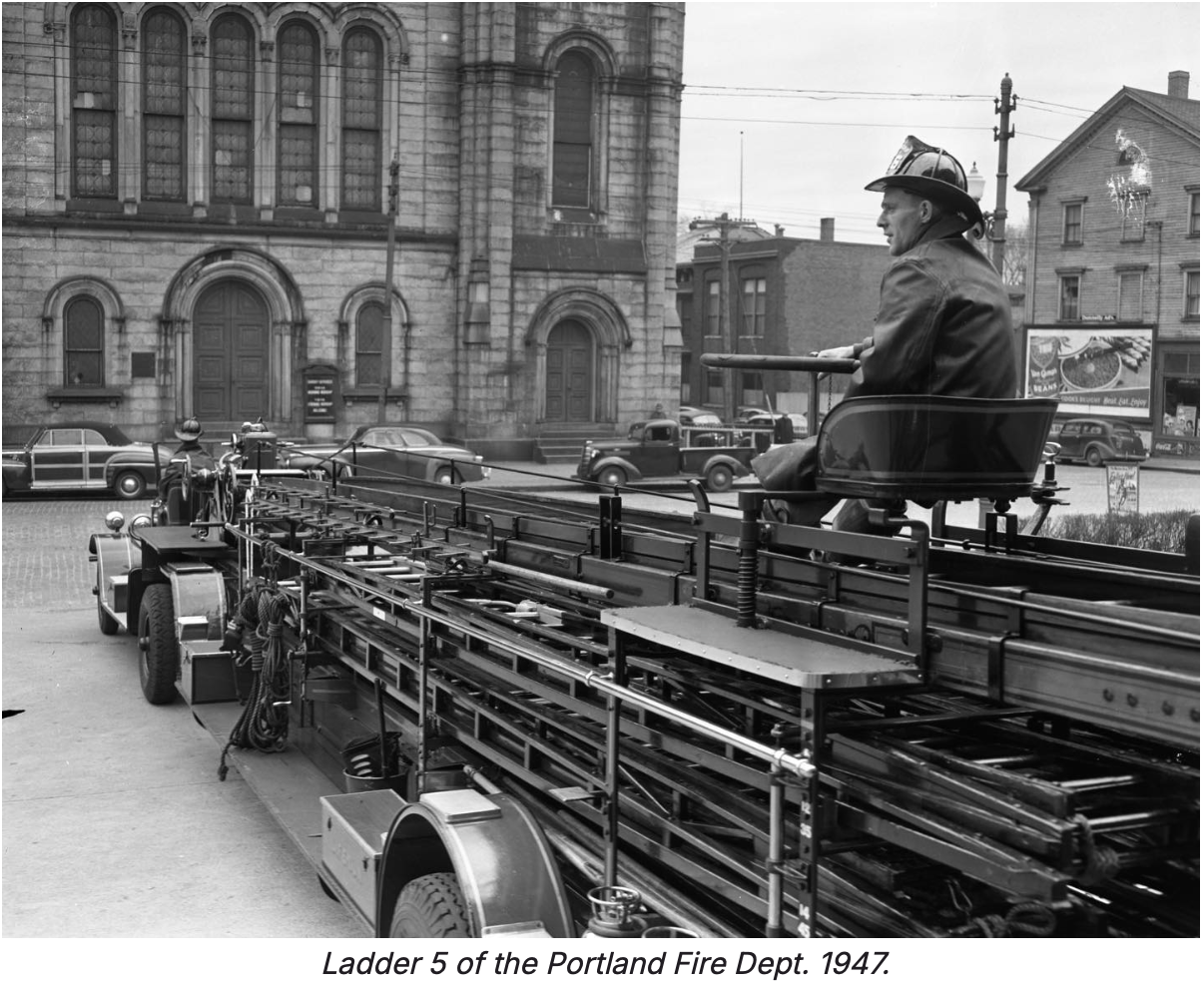
Although Portland firefighters no longer had a union, they continued to advocate for a two-platoon system that would divide the fire company into two 84-hour shifts. Under the continuous schedule that had been in place for a century, they were on duty 120 hours a week with just 48 hours off. They basically lived at the fire house and came home for some meals. They had long argued that a two-platoon system would be more efficient and would reduce insurance costs. But every year they came back to the city with the proposal, it was shot down due to the upfront cost.
Biddeford became the first city in Maine to establish the two-platoon system in 1930. The Board of Councilmen unanimously passed the measure, which increased the fire department’s payroll by $4,500. It allowed for firemen to work 14 hours one day and 10 hours the following day. The Biddeford Fire Dept. threw a banquet for Mayor George C. Precourt and members of the city government in appreciation for passing the historic ordinance. However, as the Depression took its toll on city finances, the council decided it could no longer justify the cost and ended up scrapping the two-platoon system in 1935.
Between 1930 and 1940, other towns like Bangor, Waterville and South Portland considered similar proposals but they never went anywhere. Still, they made a good case for it, noting that President Franklin D. Roosevelt’s New Deal policies had brought the eight-hour day to other sectors of the economy.
By the early 1940s, the wartime economy was creating thousands of jobs in Maine’s heavily unionized manufacturing industries as the U.S. began shipping supplies to the allies in Europe and building its “arsenal of democracy” to fight the Axis Powers. With more opportunities for better paying union jobs in the South Portland shipyards and unemployment dropping, firefighters had more leverage to demand better wages and benefits. In Feb. 1940, Portland Fire Chief Oliver T. Sanborn made another push for the two-platoon system, arguing that of the 205 cities of 50,000 population or more, only Greensboro, NC and Portland, Me fire departments didn't have a two or three platoon system. By that time, Portland firemen worked three days on and one day off.
In 1942, the Portland firefighters submitted petitions to the City Council asking for 20 percent pay increases, 15 days of sick leave and full weekly pay to firefighters who were unable to work due to sickness or injury sustained in the line of duty. As Captain L. H. Murray told reporters, “We’re not asking for a raise to be able to compete with the shipyards, but we would like to be on a par with other departments of comparable size.”
He noted that other cities of the same size gave firefighters full pay for injuries or sickness. In fact, Portland’s city charter made sick pay mandatory for police and firefighters. Sick time had actually been granted to firefighters after the City Council form of government was implemented in 1923, but gradually the benefits were taken away during Barlow’s tenure. As we covered in our last column, firefighter William E. Fuller tried to petition the Portland City Council for his pay while dying in the hospital of injuries he sustained on the job in 1929, but was rebuffed by City Manager Barlow who argued that there was a “danger of establishing a precedent” if they made exception for the ailing fireman.
Captain Murray pointed out to the City Council that Manchester, NH was the only city of comparable size in New England that did not have a two-platoon system. He added that a dozen New England cities of comparable size to Portland paid firefighters better.
But the conservative City Council and its reactionary City Manager would not budge. If one group of public employees were given raises, Councilman Harry A. Martin told firefighters, the rest would expect similar increases in salary and the city couldn’t afford to do that. City Manager Barlow agreed, predicting that if city employees were paid better the city could suffer a financial collapse. But not all of the councilors agreed. Councilor Adam P. Leighton responded, “I’m all for raising their pay. They can’t live on what they’re making now and the two departments are needed for protection of the City. We have to keep them satisfied or we will lose them to the war industries.”
Although Leighton’s colleagues on the Council disagreed that firemen were paid less than shipbuilders, Barlow later released a report contradicting their assessment. He acknowledged that inflation had eroded municipal workers’ wages, but that the city “cannot compete with wages paid to defense workers" because it would "[cause] a breakdown in real estate values due to over-taxation.” However, his fixation on keeping taxes low and budgets austere was not sustainable in the booming wartime economy.
By 1942, the South Portland shipyards and Bath Iron Works had hired 10,200 shipbuilders in just two years to meet production demands. The South Portland yards soon employed 25,000 workers, most of them members of the mighty CIO’s Industrial Union of Marine and Shipyard Workers of America (IUMSWA) Local 50. In November 1942, the Portland Press Heraldreported that several Biddeford firemen had taken better paying jobs in construction in Portland, leaving just nine men on the department. The Portland Fire Department had already 50 members in the past year and half and the chief expected to lose a dozen more by the end of the year.
Portland Firefighters Form IAFF 740
On Nov. 17, 1942, the Portland firefighters announced that they were reforming their union with the International Association of Fire Fighters (IAFF). It was their first major union drive since their first union, IAFF Local 133, dissolved in the early 1920s. More than 90 percent of the firemen signed union cards.
The same day, the city granted a 5 percent wage increase to all municipal employees except teachers, laborers, truck drivers, mechanics, and foremen in public works and parks and recreation. Municipal workers had already received a 10 percent bonus increase since March. But the firefighters were not impressed as the Council had yet again ignored their requests for sick pay and a two-platoon system. After the vote on Nov. 20, Capt. Lawrence H. Murray told the City Council, “Members of the Department will be dissatisfied with the action you have taken tonight.”
Lieut. Joseph Fortier said firefighters had been “on the fence” awaiting the outcome of that night’s meeting and declared that “the five percent increase will not benefit us.” The firefighters made it clear that they also wanted a reduction from the 109-hour week, financial protections for firemen injured in the line of duty and reimbursement for the purchase of their own uniforms and personal equipment. Horace A. Howe, an IBEW lineman and president of the Portland Central Labor Union (now known as the Southern Maine Labor Council), urged the Council to reconsider as staffing shortages had reached an “alarming stage.”
“Our organization is 100 percent behind the firemen and all other city employees in their just and fair request that they receive an increase in pay,” said Howe.
City Manager Barlow was not about to recognize a municipal employee union in his town. At a local Rotary Club meeting, Barlow even went as far as to question the patriotism of Portland firefighters, stating that they owed it to the troops serving in armed forces overseas to keep down expenses at home. He argued that the Portland Fire and Police Departments are considered “semi-military organizations” and thus should be considered ineligible to join unions. Capt. Lawrence Murray fired back that a majority of the firemen “are all steamed up for organization” and they wouldn’t need to organize “if we were granted what should be given us.” While the City Council acknowledged that the firefighters had a right to affiliate with an international union, they voted unanimously to oppose sanctioning it.
Councilor Adam P. Leighton asked the firefighters if “some sort of a local club, say a “Fire-Fighters’ Club’ with a president and officers” would satisfy the men. In response to the firefighters' request for a grievance committee, Councilor Harry E. Martin suggested the Council would only meet with a grievance committee from a “local firemen’s club” and not an international union.
“We don’t want to discuss local problems with any foreigners,” Leighton said, referring to IAFF staff negotiators and representatives. “We don’t like bulldozing or threats and I’m sure we could get much better results sitting down with a committee elected from you men.”
However, Captain Murray responded that even pay raises and the establishment of a grievance committee might not satisfy his members. “They want the two-platoon system,” he said, adding that “they have that system in every large city comparable to Portland.”
That proposal was a non-starter for Barlow. He immediately shook his head, stating, “it would require 30 additional men and probably cost the city $60,000 annually.” Murray replied that the men felt that “it might cost the City that much or more if Portland lost its present high rating on fire insurance rates.”
“What are you going to do if the Fire Department continues to lose men at the present rate of resignation and is unable to replace them,” Lieutenant Chester R. McAlister asked the Council. “No man with any ambition is going to take a job that starts at $29.75 these days.”
Murray explained that Portland firefighters also wanted to affiliate with the IAFF because it could provide sick and death benefits as well as a grievance clause. Firefighter Fred S. Shuman, a private in the department added that “we wouldn’t want to join an outside union unless the City Government approved. We don’t want to rush into anything and we don’t want to cause any trouble.” However, Councilor Edward C. Berry shot back that “if you should talk with the citizens of Portland, you’d find that close to 100 percent of them would be against any public safety department affiliating with a union.”
Murray pointed out that 87 of the 104 men on the department supported the union and that its proposed constitution would have a no-strike clause. Despite Barlow and the Council’s opposition to the union, the Portland firefighters went ahead with their secret ballot election and won it handily. However, following Barlow’s advice, the City Council unanimously resolved on December 23 to refuse to bargain with any “third party” union rep who was not a member of the Portland Fire Department. The City Manager cited a War Labor Board decision that it “cannot render any decisions in regard to problems and labor troubles of municipalities.” The union countered that refusing to bargain with the union was a violation of the National Relations Act, a landmark labor law that didn’t exist the first time the firefighters unionized in 1921.
Corporation Counsel W. Mayo doubted the Wagner Act could be applied to municipalities, private corporations and businesses and questioned whether “quasi-military organizations” like police and firefighters had the right to even affiliate with unions. Councilor George A. Harrison said that a “grievance committee of department members will receive the same treatment as a union representative.”
“We do not feel that the taxpayers should be made to pay the firemen’s union dues,” he declared. “I am heartily behind the firemen. I believe they should stop and consider various differences. A clause in their union calls for no strike, therefore, what benefits can be derived from their organization?”
Councilor Edward C. Berry added that he was not “opposed to organized labor,” but that “by joining a national organization, the Fire Department will lose its prestige and the confidence of Portland’s citizens than if it organized locally.”
The Council ended up passing a resolution refusing to grant approval of a national union for firemen and urged that they organize into a “purely local organization” to bring their requests, grievances and other concerns to the city.
“It would be decidedly against sound public policy for members of the Portland Fire Department to organize themselves into a union and affiliate that organization with a national or international organization,” the resolution declared.
But that was not the final word on the matter. On January 11, 1943. Portland firefighters received their charter as the first firefighter union in Maine and the tenth one in New England. The fight for a two-platoon system had just begun.